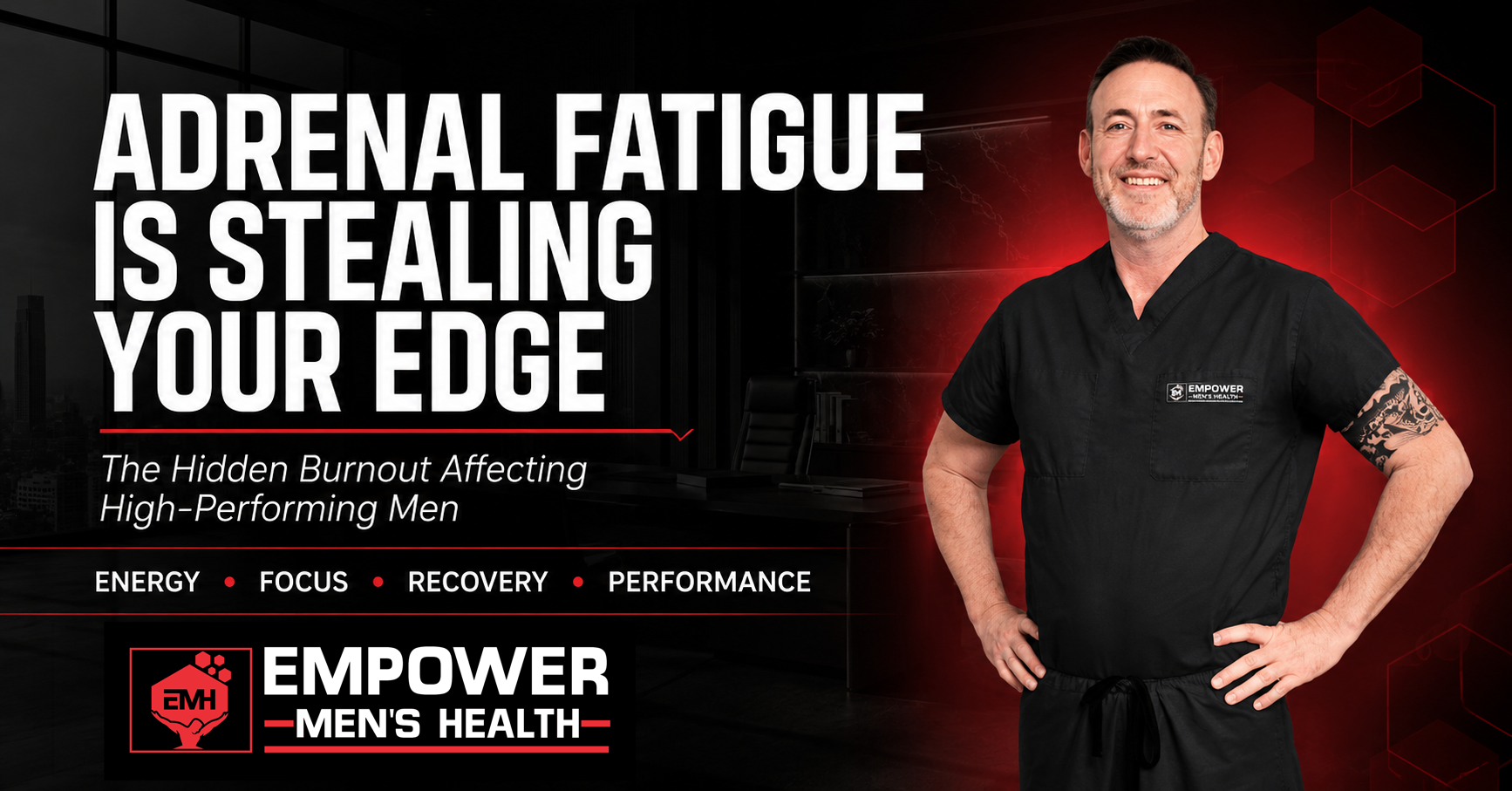
It’s one of the most common questions I hear in my office.
“Dr. Jason, why should I take testosterone?”
My answer often surprises people.
You shouldn’t take testosterone simply because you’re getting older.
You shouldn’t take testosterone because you heard about it on a podcast, saw an advertisement, or because your friend is taking it.
You should only consider testosterone if your body is no longer producing enough of it and that deficiency is negatively affecting your health, performance, and quality of life.
The truth is, testosterone isn’t the goal.
Health is the goal.
Testosterone is simply one tool that may help you get there.
What Testosterone Is Really About
Most men think testosterone is about building muscle, increasing sex drive, or looking younger.
Those things certainly matter.
But after years of caring for patients, that’s not what stands out most to me.
What I see every day is the exhausted father who comes home from work with nothing left to give his wife and children.
I see the business owner who has lost his focus and confidence.
I see the executive who used to lead from the front but now feels like he’s barely making it through the day.
I see men who tell me:
“I don’t feel like myself anymore.”
That’s probably the most common phrase I hear.
And that’s why this conversation matters.
Testosterone Doesn’t Create Success
One of the biggest misconceptions about testosterone is that it’s some kind of magic solution.
It isn’t.
Testosterone doesn’t create motivation.
It doesn’t create discipline.
It doesn’t create success.
It doesn’t fix a poor diet, eliminate stress, or replace healthy habits.
But when a man truly has low testosterone, replacing it can remove the physiological barriers that are holding him back.
I often use this analogy with patients.
Imagine driving a high-performance sports car with the parking brake partially engaged.
The engine still runs.
The car still moves.
From the outside, everything appears normal.
But you’re working much harder than necessary and never reaching the performance you’re capable of.
That’s how many men with low testosterone are living.
They’re functioning.
But they’re not thriving.
The Real Benefits Often Have Nothing To Do With Muscles
The biggest changes I see in patients aren’t always physical.
They’re relational.
A husband becomes more engaged with his wife.
A father becomes more present with his children.
A business leader starts making decisions with confidence again.
A man begins training consistently because he finally has the energy to recover.
He sleeps better.
He thinks more clearly.
He becomes more resilient when life becomes difficult.
Those improvements create a ripple effect throughout every area of life.
When hormones are optimized, many men don’t just perform better physically.
They show up better emotionally, mentally, professionally, and personally.
Everything Is Connected
One of the most important lessons I’ve learned as a physician is that low testosterone rarely affects only one aspect of a man’s life.
It affects:
- Energy
- Mood
- Sleep
- Body composition
- Recovery
- Confidence
- Motivation
- Relationships
- Performance
Because everything is connected, restoring healthy testosterone levels often improves much more than patients initially expect.
I’ve had patients come in looking for help with weight loss and discover their marriage improved.
I’ve had patients come in because of erectile dysfunction and end up becoming stronger leaders at work.
I’ve had men tell me they forgot what it felt like to wake up excited about life.
That doesn’t happen because testosterone is a miracle cure.
It happens because their physiology is finally supporting the life they’re trying to live.
One Patient I’ll Never Forget
One patient in particular reminds me why I do this work.
When he first came to see me, his health had started to take over his life.
He was overweight.
He was dealing with diabetes concerns.
He had cardiovascular issues, low energy, declining confidence, and felt like his body was working against him.
Like many men, he had spent years pushing through symptoms and ignoring warning signs.
When we evaluated him, testosterone was part of the story.
But it wasn’t the entire story.
His metabolism was struggling.
Inflammation was elevated.
His hormones were no longer supporting recovery, strength, fat loss, or energy production.
What surprised him most was realizing that all of his symptoms were connected.
The weight gain.
The fatigue.
The low motivation.
The blood sugar issues.
The poor recovery.
The loss of confidence.
They weren’t separate problems.
They were signals.
Over the following months, he lost weight, gained strength, improved his laboratory markers, and regained energy through a Total Transformation.
But the most meaningful change wasn’t measured on a lab report.
It was the return of hope.
He stopped feeling like his health was declining and started realizing he still had control over his future.
That’s why I do this work.
Because when a man gets his health back, he doesn’t just look better.
He leads better.
He loves better.
He shows up better.
He begins making decisions from strength rather than fear.
What My Own Experience Has Taught Me
One reason I connect so deeply with many of the men who walk into my office is because I understand what it feels like to carry significant responsibility.
As a surgeon, there were years filled with long hours, emergency calls, administrative responsibilities, business obligations, and the pressure that comes with caring for people.
Add family, leadership responsibilities, employees, and financial obligations, and the demands never stop.
What I’ve learned is that high performers become very good at ignoring their body’s signals.
In fact, many of us take pride in it.
We push through fatigue.
We push through stress.
We push through poor sleep.
We push through burnout.
And because we’re still functioning, we convince ourselves everything is fine.
But functioning and thriving are not the same thing.
One of the most important lessons I’ve learned is that energy isn’t something you can simply will yourself into having.
Discipline matters.
Hard work matters.
But eventually physiology wins.
If your hormones are off, your sleep is poor, your stress is unmanaged, or your metabolism is struggling, there comes a point where determination alone cannot compensate.
That’s not weakness.
That’s biology.
The Biggest Misconception About Testosterone
The biggest misconception men have is believing testosterone is the solution.
It’s not.
Health is the solution.
Testosterone is one tool that may help you get there.
Too many men fall into one of two extremes.
They either believe testosterone will solve every problem in their life, or they believe it will somehow ruin their health.
Neither is true.
Low testosterone is often a symptom of a larger story.
Your hormones are influenced by:
- Sleep quality
- Stress levels
- Body fat
- Nutrition
- Exercise habits
- Insulin sensitivity
- Inflammation
- Alcohol consumption
- Medications
- Overall metabolic health
Sometimes testosterone is the answer.
Sometimes poor sleep is the answer.
Sometimes stress is the answer.
Sometimes metabolic dysfunction is the answer.
Most often, it’s a combination of factors.
That’s why I always tell patients not to ask:
“How do I raise my testosterone?”
Instead ask:
“How do I become healthier?”
When you focus on becoming healthier, your hormones, metabolism, body composition, energy, and longevity often improve together.
How I Determine Whether Testosterone Is Right For You
When a man comes into Empower Men’s Health asking whether testosterone might help him, the first thing I tell him is:
“I don’t know yet.”
And that’s the honest answer.
I refuse to prescribe testosterone based solely on symptoms because symptoms can be misleading.
Fatigue could be low testosterone.
It could also be poor sleep, chronic stress, inflammation, insulin resistance, nutritional deficiencies, depression, or metabolic dysfunction.
If I prescribe testosterone without understanding what’s truly happening inside the body, I’m guessing.
Patients deserve better than guesses.
That’s why our evaluation process is comprehensive.
We review symptoms, lifestyle, stress levels, sleep quality, exercise habits, nutrition, medical history, medications, and goals.
We then perform extensive testing that often includes more than 70 biomarkers.
We evaluate:
- Total testosterone
- Free testosterone
- SHBG
- Estradiol
- DHEA
- Thyroid function
- Blood sugar and insulin markers
- Inflammatory markers
- Nutritional markers
- Lipid markers
- Liver and kidney function
- Additional hormone and metabolic markers
We also utilize advanced tools like Evolt 360 body composition analysis and PNOE metabolic testing to evaluate factors that standard laboratory testing often misses.
Because hormones don’t operate independently.
Everything affects everything.
The goal is not to create the highest testosterone number possible.
The goal is to create the healthiest version of that individual patient.
Getting Yourself Back
The real question isn’t:
“Should I take testosterone?”
The real question is:
“Why doesn’t my body feel, perform, and recover the way it should?”
If testosterone is part of that answer, then replacing it can be life-changing.
Not because it makes you superhuman.
Not because it’s a shortcut.
Not because it’s a miracle.
But because it helps restore the version of yourself that you’ve been missing.
In my experience, most men are not afraid of aging.
They’re afraid of losing capability.
They’re afraid of losing their edge.
They’re afraid of becoming spectators in a life they used to actively lead.
The good news is that many men discover the energy, confidence, focus, strength, and drive they thought were gone forever are still there.
They simply need the right environment to return.
That’s what this work is really about.
It’s not about becoming someone else.
It’s about getting yourself back.